Skip to content
CitizenTest
  • Help
    • Help Center
    • Contact Us
  • Resources
    • Study Guide
    • Practice Tests
    • Simulation Tests
    • Flashcards
    • Preparation Tools
      • Eligibility Checker
      • Physical Presence Calculator
      • Application Checklist
      • Ceremony Checklist
      • Frequently Asked Questions
      • Application Tracker
      • Interactive Map
      • Glossary
en_CA EN
en_CA EN fr_CA FR
Pass the first time, guaranteed
Login
Pass the first time, guaranteed
Take practice tests
CitizenTest
  • Help
    • Help Center
    • Contact Us
  • Resources
    • Study Guide
    • Practice Tests
    • Simulation Tests
    • Flashcards
    • Preparation Tools
      • Eligibility Checker
      • Physical Presence Calculator
      • Application Checklist
      • Ceremony Checklist
      • Frequently Asked Questions
      • Application Tracker
      • Interactive Map
      • Glossary
en_CA EN
en_CA EN fr_CA FR
    All Simulation Tests

    Simulation Test No. 1

    All Tests Restart

    Your Progress

    1
    2
    3
    4
    5
    6
    7
    8
    9
    10
    11
    12
    13
    14
    15
    16
    17
    18
    19
    20

    How to pass the first time

    • Try free tests
    • Complete all Chapters Tests
    • Prepare with Simulation Tests
    Pass with Premium, Guaranteed
    100% Money Back. Pass Guarantee.

    Simulation Test No. 1

    Test your Canadian Knowledge

    Based on the official Study Guide

    Updated for March 2026

    Questions:

    20

    Mistakes allowed:

    0

    Passing score:

    100%

    My score:

    -

    What to expect on the official Test

    • How many questions:
    • Correct answers to pass:
    • Passing score
    • Required for ages
    • 20
    • 15
    • 75%
    • 18–54

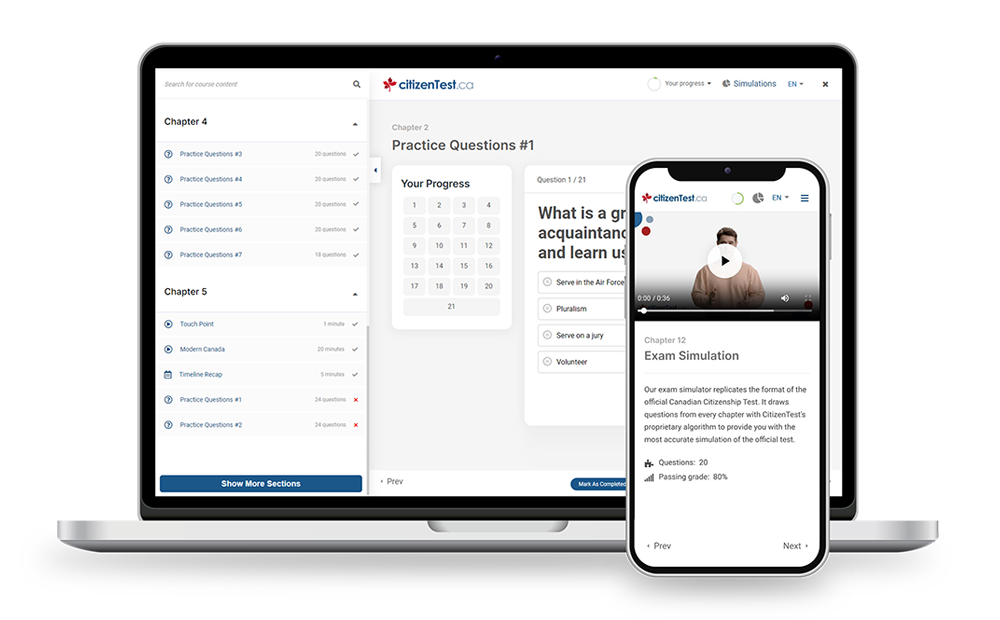
    Test your knowledge of Canada with our free Canadian Citizenship Test Simulation. Our exam simulator is designed to offer a comprehensive and accurate preparation experience by drawing questions from every chapter of Discover Canada. Using our proprietary algorithm, we ensure that the questions presented closely mirror the format and difficulty of the official Canadian Citizenship Test.

    4.9 Rating - 1,216 votes
    • Perfect for first-time applicants, re-testers, and newcomers preparing for citizenship
    • Triple-checked for accuracy

    About this test

    • 20 Questions
    • Instant Answer feedback
    • Topic Weakness Detection
    • Detailed Explanations
    Pass the first time with Premium

    About this test

    • 20 Questions
    • Available in EN, FR
    Verified by Lisa Thompson, P1, Chief Educational Researcher, Member of LSUC. See our detailed commitment to accuracy and quality in our practice tests.
    • 20 Questions
    • Instant Answer feedback
    • Topic Weakness Detection
    • Detailed Explanations

    Ensuring the accuracy and quality of our practice tests is paramount. Learn more about our rigorous standards in our Commitment to Accuracy article.

    What to expect on the actual Test:

    • 20 Questions
    • The test is 45 minutes long
    • 75% passing score
    • Required for ages 18–54

    More Simulations

    • Simulation Test 1
    • Simulation Test 2
    • Simulation Test 3
    • Simulation Test 4
    • Simulation Test 5
    • Simulation Test 6
    • Marathon Simulation Test

    1 / 20

    Who are the representatives for the First Nations?

    Study Assistant

    The First Nations have band chiefs and councillors who have major responsibilities on First Nations reserves, including housing, schools and other services.

    The representatives for the First Nations are individuals who speak on behalf of their communities and are often involved in leadership roles within their respective bands, organizations, and governments. This includes Chiefs and band council members, who are elected by their communities.

    Additionally, national organizations such as the Assembly of First Nations (AFN) also represent First Nations peoples at a broader level, with the National Chief being a key figure in advocating for their rights and interests.

    First Nations in Canada are represented by their own leadership structures, which are crucial in the governance and advocacy for their communities. These representatives are typically elected chiefs and councilors who hold positions within their respective bands or tribal councils. Chiefs and councilors make decisions on behalf of their communities and engage with various levels of government to ensure that the rights, treaties, and interests of the First Nations people are respected and upheld.

    In addition to individual band councils, there are national organizations that represent the collective interests of First Nations across Canada. One prominent organization is the Assembly of First Nations (AFN), which consists of elected representatives from various First Nations communities. The AFN's National Chief is elected by Chiefs from across the country and serves as a key spokesperson and advocate for all First Nations issues at the national and international levels.

    These representatives and organizations play a critical role in negotiating with federal and provincial governments, addressing social, economic, and cultural concerns, and working towards the preservation and enhancement of their communities' well-being and rights. Their leadership is vital in fostering self-determination and improving the living conditions and opportunities for First Nations people in Canada.

    Explanation Give me a hint Help me understand Ask question

    2 / 20

    When were Aboriginal voting rights granted?

    Study Assistant

    Most Canadians of Asian descent had in the past been denied the vote in federal and provincial elections. In 1948 the last of these, the Japanese Canadians, gained the right to vote. Aboriginal people were granted the vote in 1960. Today every citizen over the age of 18 may vote.

    Aboriginal peoples in Canada were granted the right to vote at different times in history, depending on the time period and specific group in question. Generally speaking, one significant milestone was in 1960, when the federal government passed legislation that allowed all Aboriginal people to vote in federal elections without having to give up their treaty rights or status under the Indian Act.

    Aboriginal peoples in Canada, which includes First Nations, Métis, and Inuit, were granted the right to vote at the federal level without losing their treaty status and rights in 1960. Prior to this, many Indigenous people faced various discriminatory laws and policies that severely restricted their voting rights. The landmark change came under the leadership of Prime Minister John Diefenbaker, who was instrumental in removing these discriminatory restrictions.

    Before 1960, Indigenous people had to give up their treaty rights and "Indian status" to be eligible to vote in federal elections, which was a significant barrier and a form of assimilation policy. The removal of these restrictions marked an important step towards recognizing and respecting the rights of Indigenous peoples in Canada and ensuring their full participation in the democratic process.

    Explanation Give me a hint Help me understand Ask question

    3 / 20

    Who first adopted the maple leaf as a symbol in Canada?

    Study Assistant

    The maple leaf is Canada’s best-known symbol. Maple leaves were adopted as a symbol by French Canadians in the 1700s, have appeared on Canadian uniforms and insignia since the 1850s, and are carved into the headstones of our fallen soldiers buried overseas and in Canada.

    The maple leaf has long been associated with Canadian identity and the natural beauty of the country's vast forests. It has been recognized as a symbol of the nation and its resources, often appearing in various forms of cultural and official emblematic expressions.

    In Canadian history, it was first adopted as a formal symbol by an organization that played a significant role in the country's military heritage. This adoption helped to cement the maple leaf as an enduring emblem of Canadian pride and unity.

    The maple leaf has deep-rooted significance in Canadian history and culture, symbolizing the country's natural beauty and heritage. It was first adopted as a national symbol by the French Canadians in the eighteenth century. The leaf was chosen for its prevalent presence and striking appearance, making it an ideal emblem of Canada’s vast natural landscapes.

    Later, in the nineteenth century, the maple leaf became a key symbol of Canadian identity and unity. Its adoption as a prominent symbol continued to grow, eventually leading it to be featured on the national flag of Canada, established in 1965. Today, the maple leaf stands as a powerful representation of Canadian pride and values.

    Explanation Give me a hint Help me understand Ask question

    4 / 20

    Which of the following are Atlantic Provinces?

    Study Assistant

    The Atlantic Provinces are Newfoundland and Labrador, Nova Scotia, New Brunswick and Prince Edward Island.

    The Atlantic Provinces of Canada are located on the eastern coast of the country. These provinces have a strong maritime culture and heritage, characterized by their proximity to the Atlantic Ocean. They include regions known for their historical significance, seafood industries, and distinct cultural identities.

    The provinces in this region include Newfoundland and Labrador, New Brunswick, Nova Scotia, and Prince Edward Island. These areas are known for their beautiful coastal landscapes, fisheries, and vibrant communities. Knowing their collective characteristics can help you identify them as the Atlantic Provinces.

    The question is asking you to identify which of the Canadian provinces are located in the Atlantic region. Canada is divided into various geographic areas, and the Atlantic Provinces are those that are situated along the Atlantic coast. These provinces are known for their maritime culture, seafood, and vibrant coastal communities.

    There are four Atlantic Provinces in Canada: Newfoundland and Labrador, Prince Edward Island, Nova Scotia, and New Brunswick. Each of these provinces has its own unique geography, history, and cultural heritage that contribute to Canada's diversity. These provinces are important for their natural resources, tourism, and their role in the early history of Canada.

    Explanation Give me a hint Help me understand Ask question

    5 / 20

    Who was Canada’s First Prime Minister?

    Study Assistant

    In 1867, Sir John Alexander Macdonald, a Father of Confederation, became Canada’s first Prime Minister. Born in Scotland on January 11, 1815, he came to Upper Canada as a child.

    To determine the answer, identify the significant historical figure who played a pivotal role in the establishment of Canada as a country. This individual is often referred to as the "Father of Confederation" due to his efforts in bringing together various colonies to form the new nation in 1867. His first name is John, and his last name is synonymous with a common Scottish surname.

    Sir John Alexander Macdonald was Canada’s first Prime Minister. As one of the Founding Fathers of Canada, he played a critical role in the Confederation process. His leadership was instrumental in bringing together the provinces to form the Dominion of Canada on July 1, 1867.

    Born in Scotland in 1815, Macdonald immigrated to Upper Canada (now Ontario) with his family in 1820. His political career began in the 1840s, and he was a driving force behind many of Canada’s early policies and infrastructure projects, including the creation of the Canadian Pacific Railway, which united the country from coast to coast.

    Explanation Give me a hint Help me understand Ask question

    Simulation Tests
    Prev
    Simulation Test #2
    Next
    Pass the first time, guaranteed
    Login
    • Help
      • Help Center
      • Contact Us
    • Resources
      • Study Guide
      • Practice Tests
      • Simulation Tests
      • Flashcards
      • Preparation Tools
        • Eligibility Checker
        • Physical Presence Calculator
        • Application Checklist
        • Ceremony Checklist
        • Frequently Asked Questions
        • Application Tracker
        • Interactive Map
        • Glossary
    Back to all Simulation Tests
    • Chapter 1
    • Chapter 2
    • Help
      • Help Center
      • Contact Us
    • Resources
      • Study Guide
      • Practice Tests
      • Simulation Tests
      • Flashcards
      • Preparation Tools

    Prepare confidently for the Canadian Citizenship Test with CitizenTest's trusted tools and resources. Start today and set yourself up for success on your first try.
    1-647-846-5929 support@citizentest.ca

    Support

    • Help Center
    • Contact Us
    • Terms of Service
    • Privacy Policy

    Platform

    • Success Stories
    • Who We Are
    • Blog & Updates
    • Application Tracker

    Resources

    • Study Guide
    • Practice Tests
    • Simulation Tests
    • Flashcards

    Copyright © 2026  - All rights reserved. Proudly Canadian 

    ×
    Premium Exclusive

    Premium Feature

    Feature Image
    This chapter includes

    This is only available for Premium members. Upgrade now to unlock all content and features.

    Get Full Access